
How to Write a Demand Letter for Money Owed (2026 Guide)
Someone owes you money. You've asked nicely. You've reminded them. You've waited. And now you're sitting there wondering: What do I actually do next?
You're not alone. Millions of Americans are owed money every year — by former roommates, freelance clients, landlords, contractors, even friends and family. And most of them have no idea how to professionally ask for it back without hiring a lawyer.
That's where a demand letter comes in. It's a formal written request that tells the other person exactly how much they owe, why they owe it, and what happens if they don't pay. It's professional. It's documented. And it works — studies show that 30-50% of people pay after receiving one. (The American LegalNet survey on debt collection correspondence puts pre-litigation settlement rates in that range for documented demand letters.)
This guide covers everything: what to include in a demand letter, how to write it step by step, common mistakes to avoid, and how to send it so it actually gets results. We'll even show you how to write a demand letter for money owed in minutes using Claimdra's demand letter tool if you'd rather skip the template and get straight to action.
What Is a Demand Letter for Money Owed and Why It Works
A demand letter is a formal document demanding payment. But calling it "just a letter" undersells what it does.
The legal significance
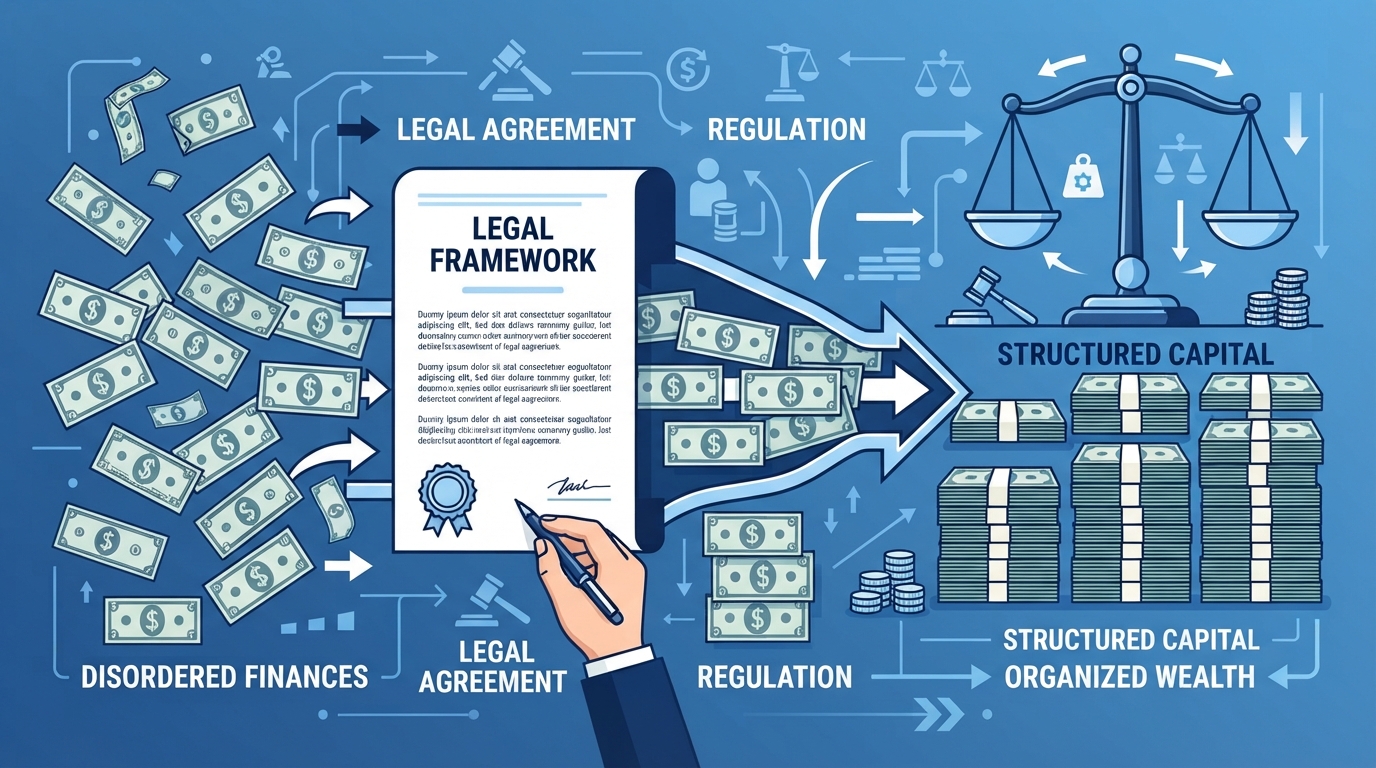
Legally, a demand letter establishes that you gave the other party a reasonable chance to resolve the issue before taking further action. If you end up in small claims court, that letter becomes evidence — proof that you didn't just file a lawsuit out of nowhere. You tried to work it out first. Judges respect that.
The psychology behind getting paid
There's also a simpler reason demand letters work: they signal seriousness. A casual "hey, you still owe me that money" is easy to ignore. A typed, formatted, professionally structured letter sent by certified mail? That's harder to brush off. It tells the recipient: This person is organized. This person has a case. This person might actually take me to court.
Claimdra helps you build that case from the ground up, turning your scattered texts, emails, and mental notes into a structured demand letter you can actually use.
When to Send a Demand Letter for Money Owed
Timing matters. Send it too early and you risk damaging a relationship that could've been salvaged. Send it too late and you might run into statute of limitations problems.
Common scenarios that call for a demand letter
There are five situations where sending a formal demand is almost always the right move:
- Unpaid personal loans — You lent a friend or family member money with a promise to pay back, and the deadline came and went.
- Unpaid invoices — You're a freelancer, contractor, or small business owner and a client hasn't paid for completed work. This type of demand letter for unpaid debt is one of the most common and effective uses of the format.
- Security deposit disputes — Your landlord withheld part or all of your deposit without a valid reason.
- Property damage claims — Someone damaged your property (car, home, belongings) and refuses to cover the costs.
- Unpaid wages — An employer failed to pay you for work already performed.
When NOT to send one
A demand letter isn't always the answer. Skip it if:
- The debt is past the statute of limitations (check your state's rules)
- You have no written or verifiable evidence of the agreement
- The amount is small enough that the cost of mailing and tracking exceeds what you're owed
- The situation involves harassment, threats, or violence — go straight to law enforcement
Not sure which scenario fits your situation? Claimdra's intake process asks about your specific dispute type and tailors the demand letter to match.
What to Include in Your Demand Letter
A weak demand letter is worse than no demand letter at all. So knowing what to include in a demand letter is critical. If yours is vague, poorly formatted, or overly emotional, it signals that you're not serious — and the recipient will treat it accordingly.
The 7 essential elements
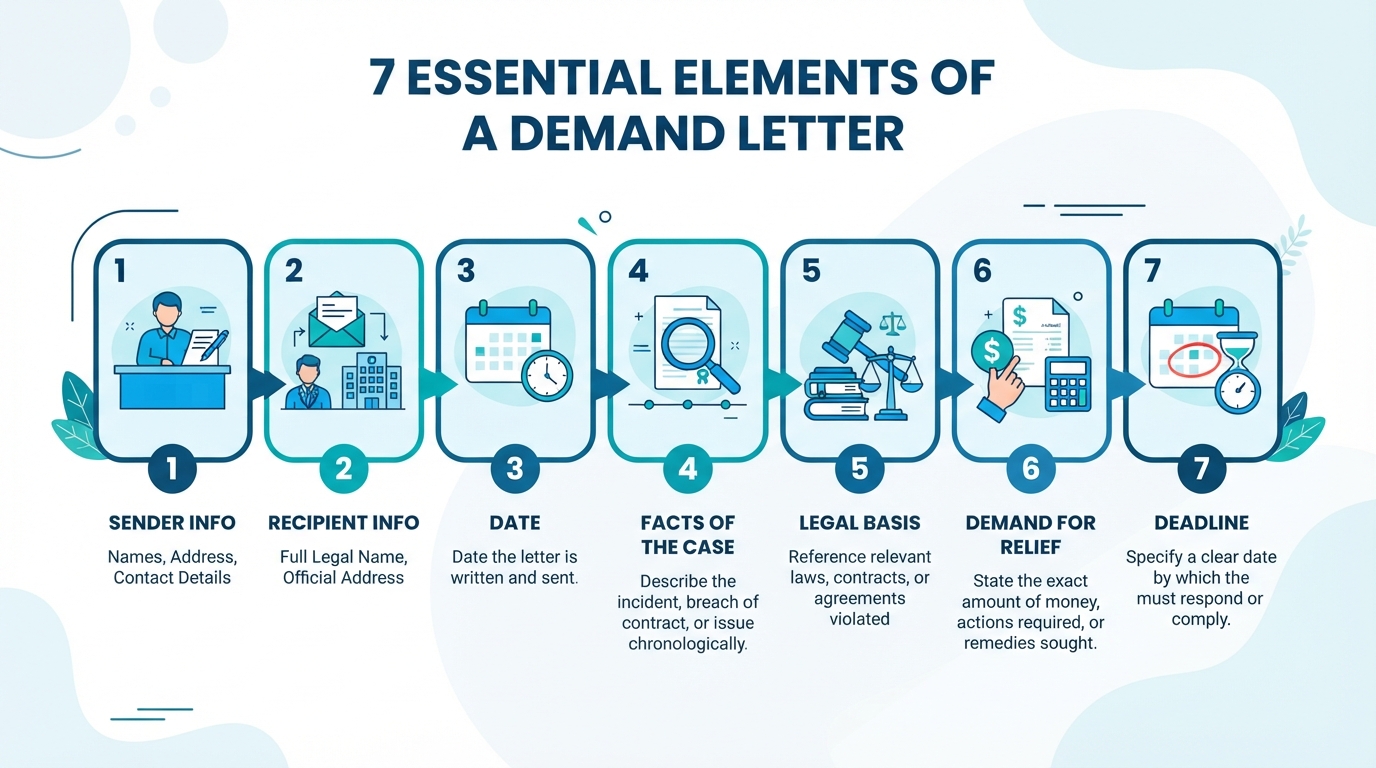
Every effective demand letter should include these seven components:
- Your contact information — Full name, address, phone number, and email at the top.
- The recipient's information — Full name and address of the person or business you're demanding payment from.
- A clear statement of facts — What happened, when it happened, and what was agreed upon. Stick to facts, not feelings.
- The exact amount owed — Be specific. Include a breakdown if the amount covers multiple items (e.g., $1,500 unpaid rent + $200 late fees = $1,700 total).
- Supporting evidence referenced — Mention any contracts, receipts, emails, text messages, or bank records that back up your claim.
- A specific deadline — Most courts consider 10-14 days reasonable. Pick a specific calendar date.
- Consequences of non-payment — State what you'll do if the deadline passes without payment (file in small claims court, send to collections, etc.).
Free demand letter template for money owed
Here's a short excerpt of effective demand letter phrasing — use this as your demand letter template for money owed that you can customize:
"This letter serves as formal notice that you have failed to pay the outstanding balance of $2,500 for freelance web development services completed on March 15, 2026, as outlined in our signed service agreement (attached). Full payment is due by July 25, 2026. If payment is not received by this date, I will file a claim in [County] Small Claims Court to recover the full amount plus filing fees."
Notice the recipe: statement of fact → specific amount → clear deadline → stated consequence. Follow this template and your letter will carry real weight.
How to Write Your Demand Letter Step by Step
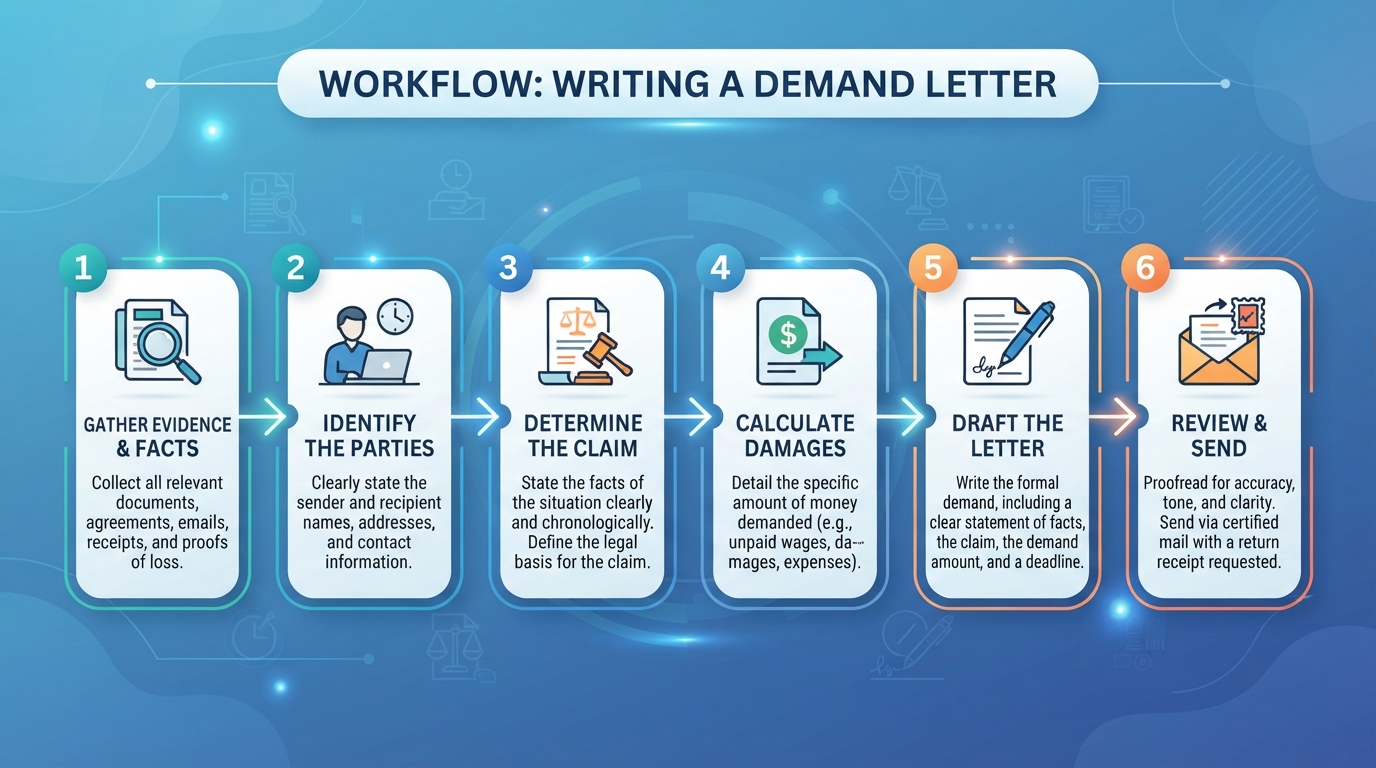
Writing your first demand letter can feel intimidating. Break it into small steps and it becomes straightforward.
Step 1: Gather your evidence
Before writing a single word, collect everything that proves the debt exists:
- Signed contracts or agreements
- Invoices and payment records
- Text messages or emails discussing the debt
- Bank transfer receipts
- Photos of damaged property (for property claims)
Evidence is what turns your demand from a complaint into a case. Don't skip this step.
Step 2: Write the opening
Start with a header containing both parties' contact information and the date. Then open with a straightforward sentence:
"This letter is a formal demand for payment of $3,200 owed under the terms of our agreement dated February 1, 2026."
Direct. Professional. No fluff.
Step 3: State the facts
Describe what happened chronologically. Keep it brief but complete. If you sent multiple reminders, mention them. If you have receipts, reference them.
Step 4: Make your demand
This is the core of the letter. State exactly what you want — how much money, by what deadline, and how they should pay (e.g., bank transfer, check, payment portal link).
Step 5: Set a deadline and consequences
Choose a reasonable deadline (10-14 days is standard for simple debts, 30 days for more complex disputes). Then state clearly what happens if they miss it.
Step 6: Close professionally
End with your signature block and a note that you're open to discussing a resolution. This isn't an ultimatum — it's an invitation to settle before things escalate.
If this sounds like a lot of steps, it is. That's why Claimdra built a guided system that walks you through each one with plain-language questions instead of blank templates.
How to Send Your Demand Letter for Maximum Impact
The content of your letter matters. But how you send it matters almost as much.
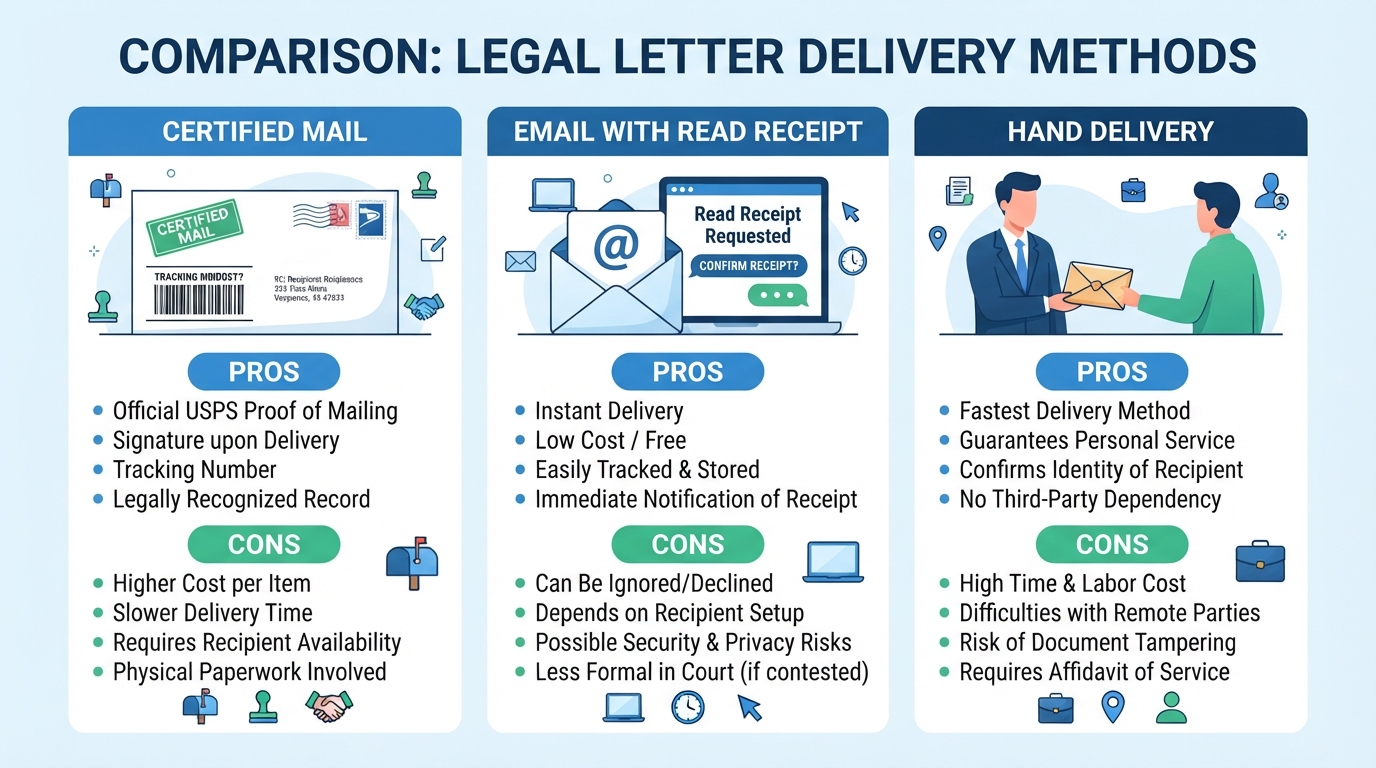
Certified mail vs. email vs. personal delivery
| Method | Pros | Cons |
|---|---|---|
| Certified Mail with Return Receipt | Legal proof of delivery, hardest to ignore, court-admissible | Costs $4-7, requires a trip to the post office ($4.85 at current USPS rates) |
| Email with Read Receipt | Free, fast, creates a digital timestamp | Easy to ignore, can be filtered as spam |
| Personal Delivery | Immediate, allows face-to-face discussion | No proof of delivery unless witnessed, can escalate emotions |
Why certified mail is the gold standard
For anything over $500, certified mail with return receipt is the way to go. According to USPS, a certified mail demand letter gives you a signed green card proving the recipient got your letter. That signature is gold in court — it shuts down any "I never got it" defense.
And here's a pro tip: Claimdra handles the mailing for you — physical, tracked, and tied directly to your case record. You write the letter in the app, review the draft, and they take care of the rest.
Before you send: Quick checklist
☐ Did I include both parties' full names and addresses? ☐ Is the amount owed specified in exact dollars (with breakdown if needed)? ☐ Did I state a specific calendar date as the deadline? ☐ Did I mention what I'll do if they don't pay? ☐ Is the tone professional and factual (no emotional language)? ☐ Did I attach or reference supporting evidence? ☐ Am I sending by certified mail with return receipt? ☐ Did I keep a copy for my records?
Run through this checklist before sealing the envelope — it catches the mistakes most people make under pressure.
5 Mistakes That Kill Your Demand Letter for Money Owed
Even a well-intentioned demand letter can backfire if you make these common errors.
1. Getting emotional instead of factual
"I can't believe you would do this after everything I've done for you" is not a legal argument. Judges don't care about feelings — they care about facts, contracts, and evidence. Keep your letter professional.
2. Being vague about the amount
"Asking for what you owe me" is not a demand. It's a complaint. Always specify the exact dollar amount with a clear breakdown. If you're claiming $500 for one thing and $200 for another, show your math.
3. Making empty threats
Don't say "I'll sue you" if you have no intention of filing. Don't threaten criminal charges for a civil debt — that can backfire legally. Only state consequences you're prepared to follow through on.
4. Sending to the wrong person or address
Double-check every detail. A letter sent to an old address or the wrong business entity isn't just wasted effort — it doesn't count legally. Confirming the recipient's current address matters, and a service like Claimdra's certified mail with tracking helps ensure it reaches the right place.
5. Not following through
If you set a 14-day deadline and then do nothing when it passes, you've trained the recipient that your words don't mean anything. If they don't pay, file in small claims court. That's the logical next step, and your demand letter already laid the groundwork.
What Happens After You Send the Demand Letter
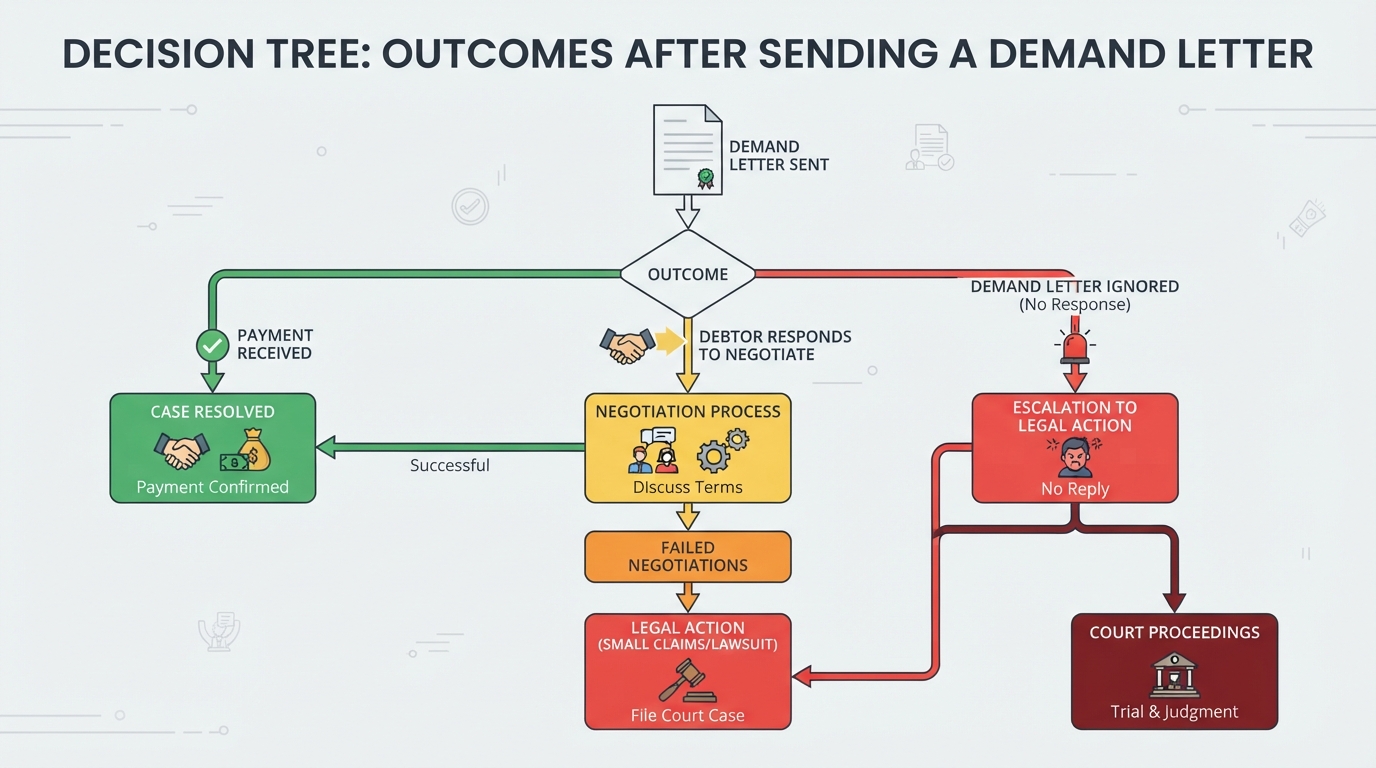
Your letter has been written, sent, and signed for. Now what?
If they pay
Congratulations. Have them sign a settlement agreement confirming the debt is fully resolved, and keep a copy for your records.
If they negotiate
Counteroffers are common. If they can't pay the full amount but offer a reasonable partial payment, consider it — a partial recovery now is often better than waiting months for a court date. Just get the agreement in writing.
If they ignore it
This is the most common outcome. Don't panic — it's actually the expected one. Your demand letter has already served its purpose: it created a documented record of your attempt to resolve the matter. Now follow through. A demand letter before small claims court is only effective if you're prepared to actually file.
Next step: small claims court
Filing a small claims case costs $30-$100 in most states (per the American Bar Association's small claims guide), and you don't need a lawyer. Bring your demand letter, the certified mail receipt, and all your evidence to the hearing. The fact that you sent a professional demand letter and the recipient ignored it looks good to a judge.
If you're unsure about the small claims process for your state, Claimdra helps you build a full case record that includes your demand letter, evidence, and court preparation — everything in one workspace.
Frequently Asked Questions
Do I need a lawyer to write a demand letter for money owed?
No. Most demand letters for straightforward debts can be written without a lawyer. For amounts under $10,000, doing it yourself is standard practice. A well-structured template or AI-guided tool is usually sufficient.
How long should I give someone to respond to a demand letter?
10 to 14 days is the standard. For complex disputes, 30 days may be more appropriate. Courts generally consider anything under 10 days unreasonably short. Per Nolo's guide on demand letters, a reasonable deadline signals good-faith effort to resolve the matter.
Can I send a demand letter by email?
You can, but certified mail is strongly preferred. Email can be ignored, filtered, or claimed unseen. Best practice: send by certified mail and also send a courtesy copy by email.
What if the person who owes me money doesn't have a written contract?
You can still send a demand letter. Oral agreements are enforceable in most states. Support your claim with bank records, text messages, emails, or witness statements that confirm the debt existed.
Is a demand letter legally binding?
No, a demand letter itself is not a court order. But it creates a paper trail, establishes that you attempted to resolve the matter, and strengthens your position if you end up in court.
Conclusion
Being owed money is stressful. But a well-written demand letter for money owed transforms your situation from "hoping they'll pay" to "professionally demanding what's yours." It documents your case, signals your seriousness, and gives you leverage — all without stepping foot in a courtroom.
The formula is simple: gather your evidence, write a clear and factual letter, send it by certified mail, and follow through if they don't respond. Do that, and you've already done more than most people ever do.
If you want to skip the formatting headaches and get straight to sending, Claimdra's platform lets you create and mail a professional demand letter in minutes. Here's how it works: describe your dispute in plain English, review the AI-generated draft, choose tracked mailing or PDF download, and your case record is saved in one workspace. No templates to fiddle with. No legal jargon to figure out. Just your facts, your demand, and a clear next step.